
'...he keeps his campaign promises, does what he said he will do which led to his huge victory.'

American businesses are lobbying with political parties here to build a consensus on stalled economic reforms such as liberalisation of foreign direct investment (FDI) in sectors like multi-brand retail, aviation and insurance, and for expeditious introduction of a Goods and Services Tax (GST).

Hints at taking support from Opposition if allies continue to show reservations

A report on South Asian countries released by the World Bank on Wednesday said that India's continuing slowdown is broad- based across sectors.
It is time for Mr Modi to be a little more reasonable and rational.

Rediff reports on the reasons behind this dramatic shift.

Singapore's long-ruling People's Action Party (PAP), led by Prime Minister Lawrence Wong, has secured a landslide victory in the country's general election. The PAP won 87 of 97 seats, with voters endorsing the party's focus on stability and economic security amidst global uncertainties. Wong expressed gratitude for the strong mandate and vowed to tackle concerns about the cost of living and housing. The results mark a significant win for the PAP, which has been in power since Singapore's independence in 1965.

US President Barack Obama remains committed to economic reforms and recovery, says White House.

In a statement issued after its Article IV Consultation with India, the IMF said that Reserve Bank of India should be ready to increase rates to check any further rise in inflation.

'If we truly wish to understand and apply Marx's insights today, we must reject the rigid dogmas that later 'Marxists' imposed in his name.'

India has opposed the International Monetary Fund's (IMF) proposal to extend fresh loans of USD 2.3 billion to Pakistan, citing concerns that the funds could be misused for financing state-sponsored cross-border terrorism. India abstained from voting at the IMF meeting, expressing concerns about Pakistan's track record and the possibility of debt financing being misused for terrorism. The IMF took note of India's statements and its abstention from the vote. India's opposition comes at a time when military conflict between India and Pakistan has intensified following a terrorist attack in Kashmir.
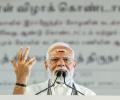
The message from Sunday's event will undoubtedly reverberate globally. It's a landmark occasion that will be remembered for generations and will inspire many other states to introduce the story of Rajendra Chola into school curricula, says Tarun Vijay.

Budget 2025-26 delivers a carefully calibrated strategy-stimulating demand and investment while keeping fiscal discipline intact. In an environment marked by global trade disruptions, and a softening in urban consumption, Finance Minister Nirmala Sitharaman has taken a measured approach.

Finance Minister Nirmala Sitharaman on Monday tabled the Economic Survey 2021-22 along with Statistical Appendix in the Lok Sabha on the first day of the Budget session of Parliament. Later, the Lok Sabha was adjourned till tomorrow. The Economic Survey will now be tabled in the Upper House. The Budget Session of the parliament commenced on January 31 with President Ram Nath Kovind's address. The first part of the Budget session of Parliament will be held from January 31 to February 11 and the second part of the Budget session will take place from March 14 to April 8.

Union Finance Minister Arun Jaitley said despite a global slowdown and its impact on countries, India remains insulated from the economic fallout.
If India grows at 6% per annum, it will take 14 years to reach the per capita income level of China and 104 years to reach the US levels. So more and speedy reforms are needed.

The prime minister was responding to a question that many of his admirers are disappointed about the slow pace of economic reforms in India.

The outlook is improving and that mostly reflects the fact that the new government has pledged to prioritise economic reforms.
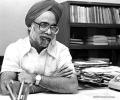
What stood out in his 15-year journey as a member of the political executive at the Centre was his glowing record as India's most successful and effective finance minister. Both as prime minister and finance minister, he understood the importance of gradualism, except when the economy or the polity was in a crisis.

There is a reason this 11 year phenomenon is a rule as much as it is an observation. It speaks to the nature of man and what humans are like, explains Aakar Patel.

He stressed that reform for him was just a way station on the long journey to the destination and the destination is the transformation of India.

Ruling out early elections, the minister said the government would last for 13 months more and would continue to take small but significant steps to ensure that the country achieves its potential growth rate of 8 per cent.
Opposition as well as UPA allies are in a mood to declare war on the Congress-led government on the FDI and fuel price issue, reports Renu Mittal
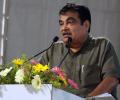
Union minister Nitin Gadkari on Friday said the Bharatiya Janata Party has been a party with a difference and that is why it has repeatedly won the trust of voters, but cautioned against the saffron outfit repeating mistakes committed by the Congress in the past which saw its exit from power.

Former Indian Prime Minister Manmohan Singh passed away at the age of 92 on Thursday. He will be given a state funeral with full state honors at Nigambodh Ghat on Saturday. Singh served as Prime Minister from 2004 to 2014 and was known for his role in India's economic reforms. Leaders from across the political spectrum paid their respects to the departed leader, highlighting his contributions to the nation.
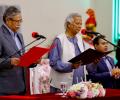
The chief adviser alleged elections held under Hasina's regime were "rigged blatantly and generations of young people grew up without exercising their voting rights."
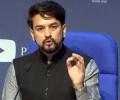
The government has only taken a pause and more measures will be announced in the days to come to help sectors hit by the coronavirus outbreak and also to make India 'Atmanirbhar Bharat', Minister of State for Finance Anurag Thakur said. Since the outbreak of the pandemic, the government has taken several steps to mitigate the hardships of the people due to lockdown and support growth, Thakur told PTI in an interview.
Finance Minister P Chidambaram on Thursday said he would reach out to all political parties to support bills on economic reforms in Parliament.

Zohram Kwame Mamdani would be the city's first Muslim and Indian American mayor if elected New York mayor this November.

The Indian government will present the annual budget for 2016-17 on February 29.

It's time India re-visited its Western alliances for the attitude and approach that the West reserves for the nation when it comes to security cooperation of the kind that they might not have visualised outside of China, India's bug-bear, asserts N Sathiya Moorthy.

The fuel reforms are a very important signal of the government's commitment to tough economic reforms.
The landslide victory of Indias ruling Bharatiya Janata Party in a crucial state poll in Gujarat will help the federal coalition government boost its economic reforms agenda and speed up its privatisation drive.
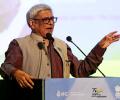
Debroy's economic interests and research work covered numerous areas such as economic theory, income inequality, and infrastructure financing.
